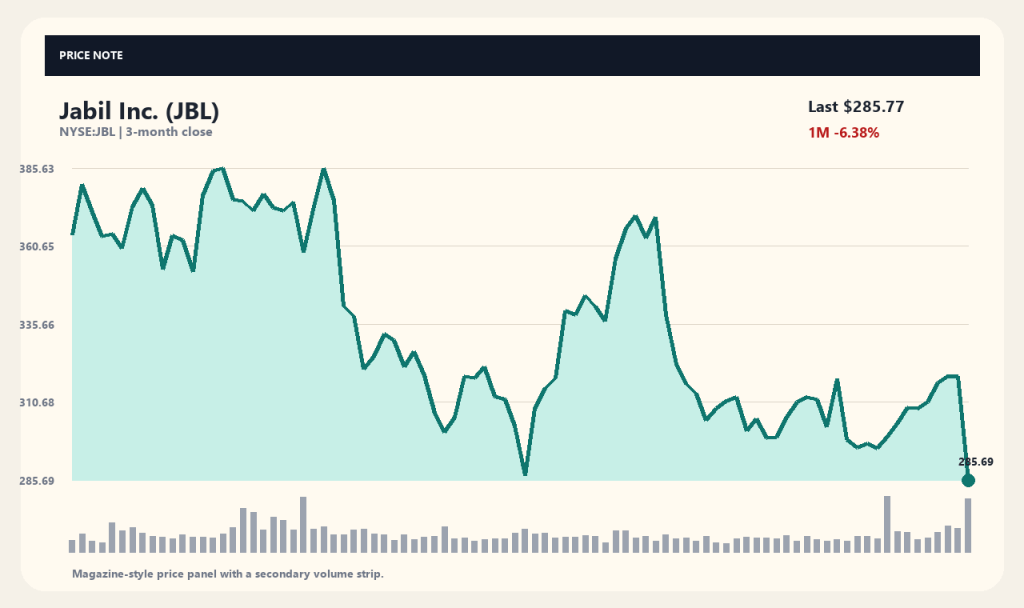
Shares of Jabil Inc. (JBL) dropped 10.37% in a single session to close at $285.77. In its latest quarterly earnings release, the company posted revenue and profit that topped Wall Street estimates while raising its full-year guidance. However, the strong report sparked a massive sell-off instead of a rally, driving the stock significantly lower.
The steep decline reflects diverging market opinions on whether high expectations for AI infrastructure demand were already priced into the stock. Major media outlets, including Barron's, noted that strong AI demand outlooks alone were not enough to satisfy Wall Street's elevated bar. Investors must analyze the gap between the reported financial metrics and the stock's downturn from multiple angles.
Record Financial Performance and Above-Consensus Guidance
Jabil reported fourth-quarter fiscal revenue of $10.62 billion, up 28.6% year-over-year. Non-GAAP earnings per share came in at $4.40, topping market expectations by approximately 8%. Surging demand across AI infrastructure and data center segments served as the primary growth catalyst for the quarter, highlighting solid demand fundamentals across core business units.
Looking ahead, Jabil issued first-quarter revenue guidance of $11.0 billion, surpassing Wall Street forecasts by roughly 9.9%. Management also outlined a long-term outlook calling for approximately 24% top-line growth in fiscal 2027, driven by a combination of AI infrastructure expansion and gains in automotive, healthcare, and energy end markets. Despite these strong projections, near-term stock reaction remains subject to shifting market sentiment and valuation standards.
Priced-In AI Expectations Trigger Post-Earnings Sell-Off
For the fourth quarter of fiscal 2026, Jabil delivered a 28.6% year-over-year revenue increase to $10.62 billion and set next-quarter revenue guidance at $11.0 billion, 9.9% above consensus. Adjusted net income reached $4.40 per share, beating expectations by 8%. Nevertheless, on September 30, 2026, the stock plummeted 10.37% in intraday trading to settle at $285.77.
According to Barron's, robust AI infrastructure growth alone failed to satisfy high market expectations. With shares already trending lower from a 52-week high of $428.93, the earnings beat proved insufficient to spark a short-term rebound. Available reporting does not fully explain all specific drivers behind the broad-based selling pressure following the beat-and-raise quarter.
Volume Spike Signals Heightened Technical Volatility
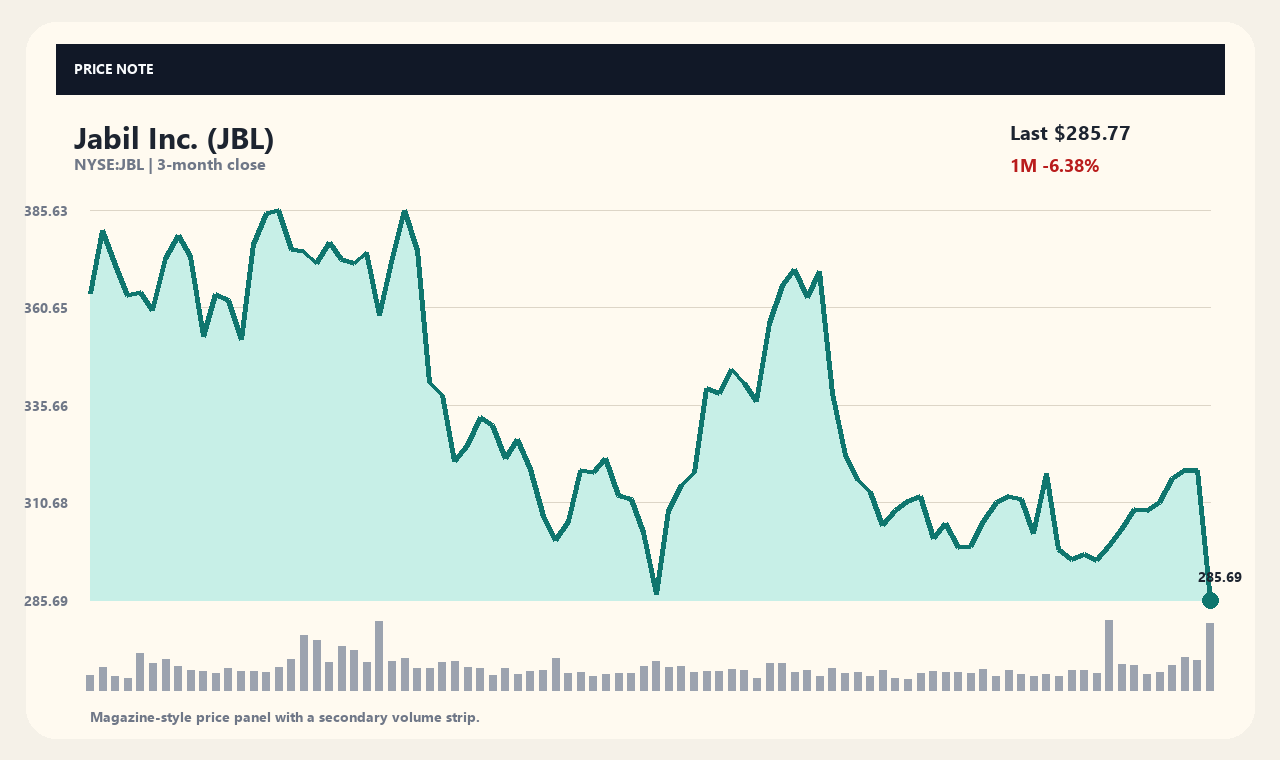
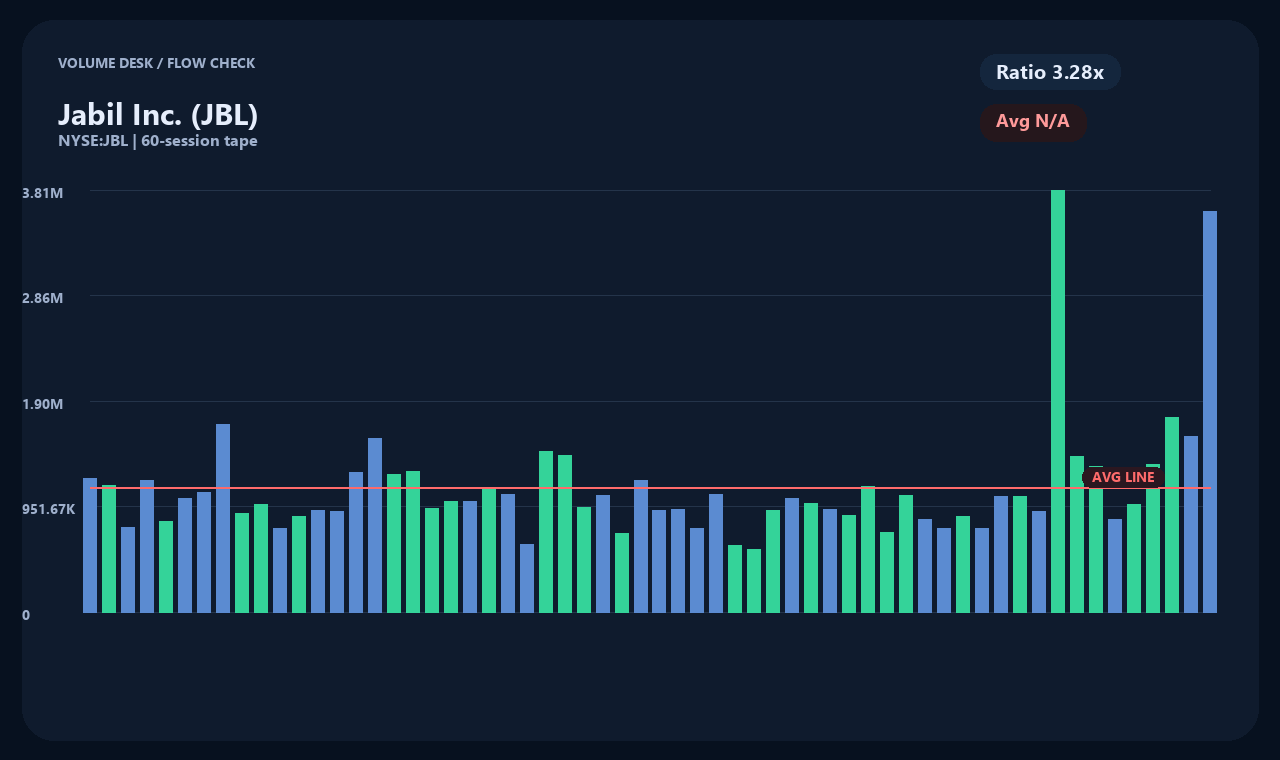
Jabil stock closed at $285.77 following the 10.37% single-day decline. Trading volume surged to 3,593,202 shares—roughly 3.28 times its average daily volume of 1,096,087 shares. The sharp drop extended the stock's recent losses to -7.44% over 1 week, -6.38% over 1 month, and -23.86% over 3 months, signaling a substantial increase in short-term price volatility.
The stock currently trades below its 20-day moving average ($306.02) and 60-day moving average ($317.78), down -6.61% and -10.07% from those key technical levels, respectively. Sitting between its 52-week high of $428.93 and 52-week low of $189.60, the stock's relative price position stands at 40.19%, reflecting immediate post-earnings repricing.
Balance Sheet Strength vs. Thin Operating Margins
Over the trailing twelve months, Jabil generated $33.59 billion in revenue and $862 million in net income. Net profit margin stood at approximately 2.57%, illustrating the structural, low-margin nature of contract manufacturing. Although revenue grew 11.8% and net income rose 27.6%, slim margins leave the company exposed to cost pressures and price competition, requiring investors to monitor margin quality alongside top-line growth.
Jabil holds $1.36 billion in cash and cash equivalents against $3.94 billion in total debt. While debt exceeds cash reserves, the company generated $1.85 billion in annual operating cash flow and $1.21 billion in free cash flow. This solid cash-generation capability helps service debt obligations and fund growth initiatives, making sustained cash flow generation a critical metric as capital expenditures rise.
Key Catalysts to Watch for Market Sentiment Reversal
The future trajectory of Jabil (JBL) hinges on its ability to execute on its fiscal 2027 revenue growth guidance of 24%. Given that shares fell despite Q4 revenue of $10.62 billion and adjusted EPS of $4.40 beating estimates, proving that AI infrastructure demand translates directly into sustained financial gains remains the core test. Investors will closely track quarterly progress against the $11.0 billion revenue target for the upcoming quarter.
In addition to data center server platforms, execution across automotive, healthcare, and energy segments will be essential alongside ongoing management of $3.943 billion in total debt. Following the 10.37% single-day drop, market perception will depend on upcoming operational results and balance sheet health as Jabil works to validate high growth expectations with concrete performance.
Data as of (2026-10-01T04:02:23): Price $285.77 USD · 1D -10.37% · 1W -7.44% · 1M -6.38% · 3M -23.86%
[Sources and Timestamps]
Market data: yahoo_chart_api · Timestamp: 2026-10-01T04:02:23. Related coverage source: Barrons.com. Article headlines serve as verification references; primary sources such as company press releases and regulatory filings should be independently verified.
This content is provided for informational purposes only and does not constitute investment advice.
This content is for informational purposes only and is not investment advice.

