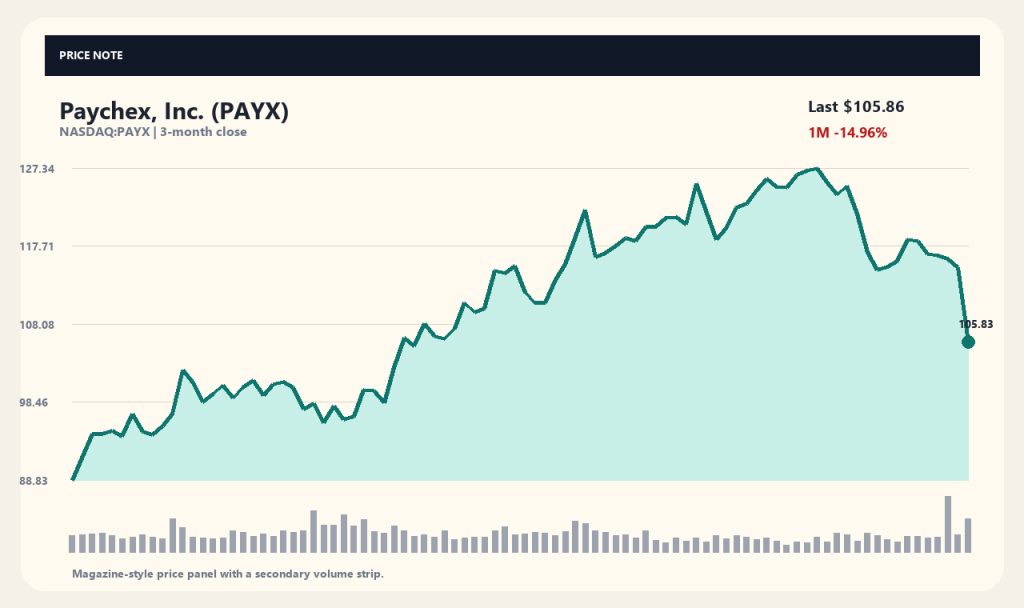
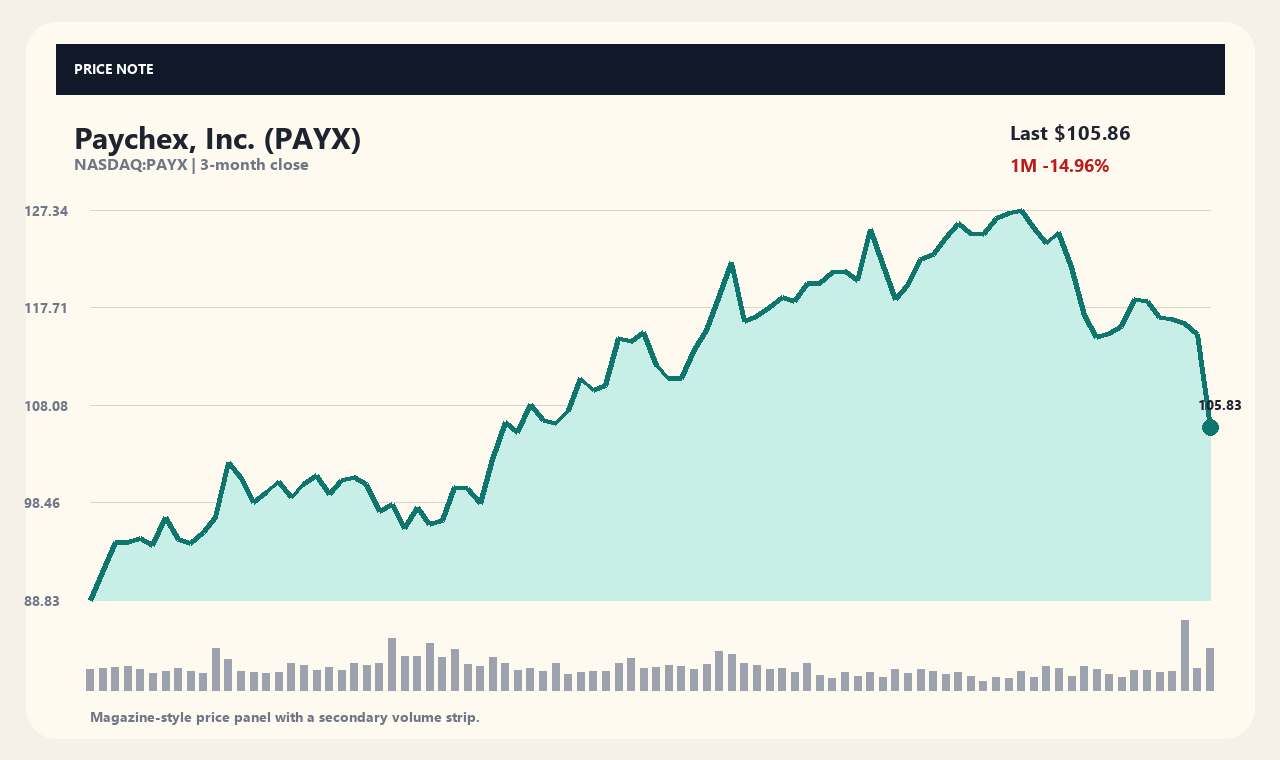
Paychex (PAYX) stock dropped 7.57% to close at $105.86 on September 23, 2026, following the release of its fiscal 2027 first-quarter earnings report. The stock fell sharply from its previous closing price of $114.53, extending its weekly decline to -10.52% and its one-month drop to -14.96%. Investors focused heavily on why the shares fell so significantly despite earnings per share beating consensus estimates slightly.
The central issue behind the sell-off was the divergence between headline profit figures and the actual growth pace of core operations. Total revenue reached $1.63 billion, rising roughly 5.88% to 6% year-over-year and meeting market expectations, while GAAP EPS grew 9.84% year-over-year to $1.34. However, market participants responded with heavy selling as they focused on signs of decelerating growth in core Management Solutions and weaker cash flow metrics.
Disconnect Between Top-Line Beats and Stock Performance
Paychex's headline first-quarter figures did not miss market expectations. EPS came in at $1.34, topping FactSet consensus estimates of $1.32, while revenue aligned well with Wall Street targets. The company maintained its full-year revenue growth guidance of 5% to 6%, signalling that its overall business strategy remains on track according to plan.
However, investors prioritized performance differences across specific segments rather than overall top-line expansion. Reports indicate that while the Professional Employer Organization (PEO) and Insurance Services segments outperformed expectations, growth in the company's core Management Solutions business moderated. Market participants expressed concern over whether this segment structure can sustain long-term growth momentum.
Detailed Financial Breakdown and Investor Reaction
Financial news outlets covering the price action pointed to underlying cash flow dynamics and guidance limitations as catalyst for the drop. Outlets including Barron's noted that moderating revenue growth alongside unchanged full-year guidance created pressure for investors. Additionally, The Motley Fool highlighted relative weakness in GAAP earnings and free cash flow metrics compared to adjusted net income.
These points are best evaluated in the context of the company's overall financial health. Paychex generates annual revenue of approximately $6.512 billion and net income of about $1.76 billion, maintaining healthy operating and net profit margins. Nevertheless, elevated focus on short-term cash generation metrics trailing adjusted earnings weakened investor sentiment.
Volume Surge and Key Moving Average Breakdown
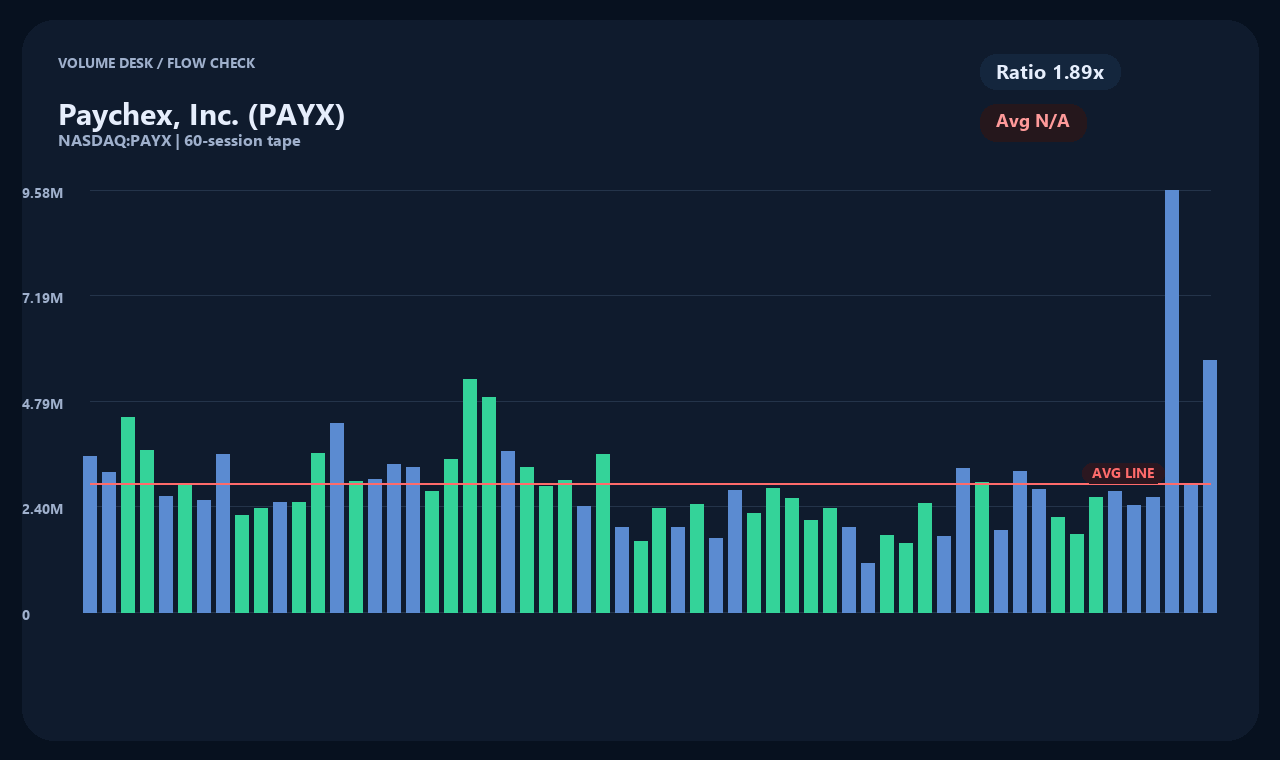
Trading volume surged to 5,697,166 shares on the day of the release, reaching approximately 1.89 times its average daily volume of 3,012,273 shares. Intra-day market data showed trading activity temporarily spiking to over six times normal volume. This elevated volume reflects heightened market disagreement and active portfolio turnover rather than outright buying pressure.
From a technical perspective, the stock broke through critical support levels. The closing price of $105.86 sits 11.67% below the 20-day moving average of $119.84 and 9.12% below the 60-day moving average of $116.47. Positioned at the 45.48th percentile within its 52-week range of $85.45 to $130.32, the stock has moved rapidly toward the lower end of its recent trading range.
AI Recruitment Launch and Operational Context
Coinciding with the earnings release, Paychex announced the launch of "WISE Hire," an AI-driven recruitment solution. According to reports from platforms such as Simply Wall St, the service automates hiring workflows and processes while keeping final decision-making power with human hiring managers. The move aims to enhance the company's Human Capital Management (HCM) platform appeal among its core small- and medium-sized business (SMB) clientele.
While adopting new technology supports product differentiation and customer retention over the medium to long term, initial revenue contributions from the new solution remain too minor to offset immediate earnings pressure. Investors reacted far more sensitively to details within the Q1 earnings report and conservative full-year guidance than to the AI integration news.
Key Factors to Watch Moving Forward
Future stock performance and valuation adjustments for Paychex will largely depend on core segment results in upcoming quarters. Meeting the full-year revenue growth guidance of 5% to 6% will require user growth recovery or higher average revenue per user in Management Solutions. Investors will also monitor whether sustained momentum in PEO and Insurance Services can sufficiently cushion softer growth in core management operations.
Additional catalysts include the recovery of cash flow metrics like free cash flow and adoption rates for the new AI recruitment tools. Investors will need to monitor upcoming filings to verify if the company can preserve revenue growth near 12.5% and net profit margins in the 27% range. External macroeconomic shifts affecting employment trends across SMBs will remain a key driver of financial performance.
Data as of (2026-09-24T04:02:26): Price $105.86 USD · 1D -7.57% · 1W -10.52% · 1M -14.96% · 3M 8.03%
[Sources and Verification Date]
Market data: yahoo_chart_api · As of: 2026-09-24T04:02:26. Coverage sources: Motley Fool, Simply Wall St. Article headlines serve as research references; primary announcements and regulatory filings should be reviewed for confirmation.
This content is prepared for informational purposes only and does not constitute investment advice.
This content is for informational purposes only and is not investment advice.

