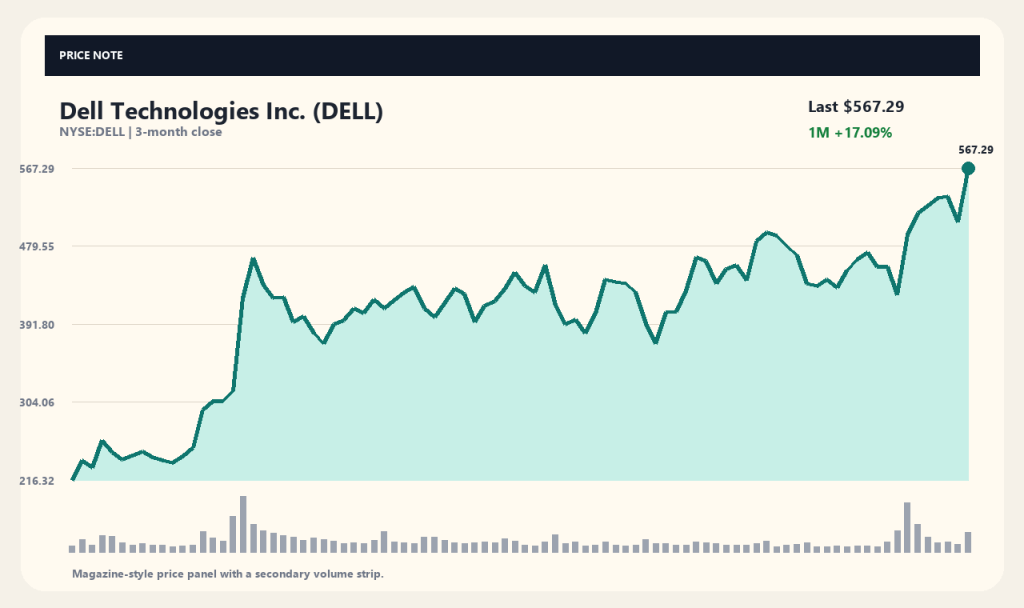
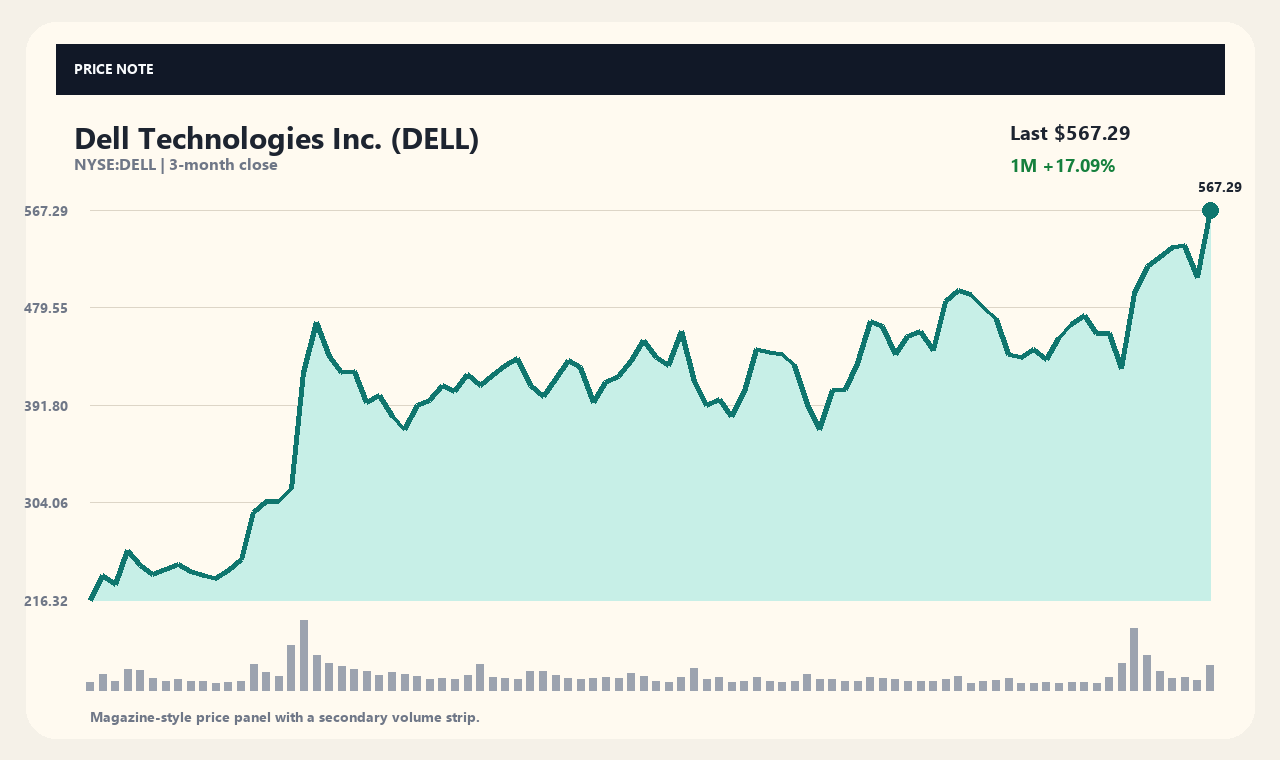
Dell Technologies (DELL) stock jumped 11.98% in a single session to close at $567.29. The sharp rally was primarily driven by a significant expansion in global backlog for artificial intelligence (AI) servers and related infrastructure, alongside upward revisions to its full-year revenue and earnings guidance. Market participants are closely watching whether Dell has successfully transformed from a traditional computer manufacturer into a high-performance AI infrastructure supplier.
Recent price action shows a strong upward trajectory, with gains of 9.86% over one week, 17.09% over one month, and 44.92% over three months. Trading near 99.9% of its 52-week high of $567.75, attention is focused on whether this upward momentum can persist. Investors require context to determine whether this guidance hike stems from temporary surge demand or signals a structural shift toward long-term profit growth.
Expanding AI Server Backlog and Upgraded Outlook
Dell Technologies is accelerating growth in its infrastructure segment to capture surging demand for AI deployments. According to reports, Dell raised its full-year guidance for the second time this year, projecting adjusted earnings per share (EPS) of $25.50 on revenue of $192 billion. Management noted that enterprises are increasingly viewing AI infrastructure spending as a key value driver rather than a routine IT expense.
Notably, data confirmed that order accumulation remains robust, with the server order backlog reaching approximately $95 billion. Speaking at the Citi TMT Conference, Dell's Chief Financial Officer highlighted that multi-year supply contracts are expanding not only for AI-related orders but also for traditional server and storage solutions. This suggests that beyond a short-term demand spike driven by the AI boom, Dell is solidifying long-term contractual commitments with its core customer base.
Shifting Revenue Dynamics in Enterprise Hardware
Dell operates through two primary segments: the Infrastructure Solutions Group (ISG), providing data center and infrastructure solutions, and the Client Solutions Group (CSG), focused on personal PCs. While CSG historically provided stable cash flow, recent profit expansion is being driven by ISG's AI-optimized servers and all-flash storage portfolio. High-performance servers command higher average selling prices and carry associated high-margin service and consulting revenues.
According to Yahoo Finance data, Dell recorded total revenue of approximately $151.197 billion and net income of around $11.378 billion. Revenue growth reached 57.7% while net income grew 272.9%, an exceptional expansion rate for a large-scale hardware vendor. However, total debt stands at roughly $35.284 billion, exceeding its cash balance of $11.570 billion, highlighting balance sheet management as a key medium- to long-term priority amid ongoing expansion.
Moving Average Disparity and Surge in Volume
From a technical perspective, the stock is currently trading 18.34% above its 20-day moving average ($479.37) and 27.79% above its 60-day moving average ($443.91). This indicates a rapid short-term advance that has pushed the share price significantly beyond its historical average levels. A high short-term disparity often increases potential stock volatility in response to minor earnings or order variables.
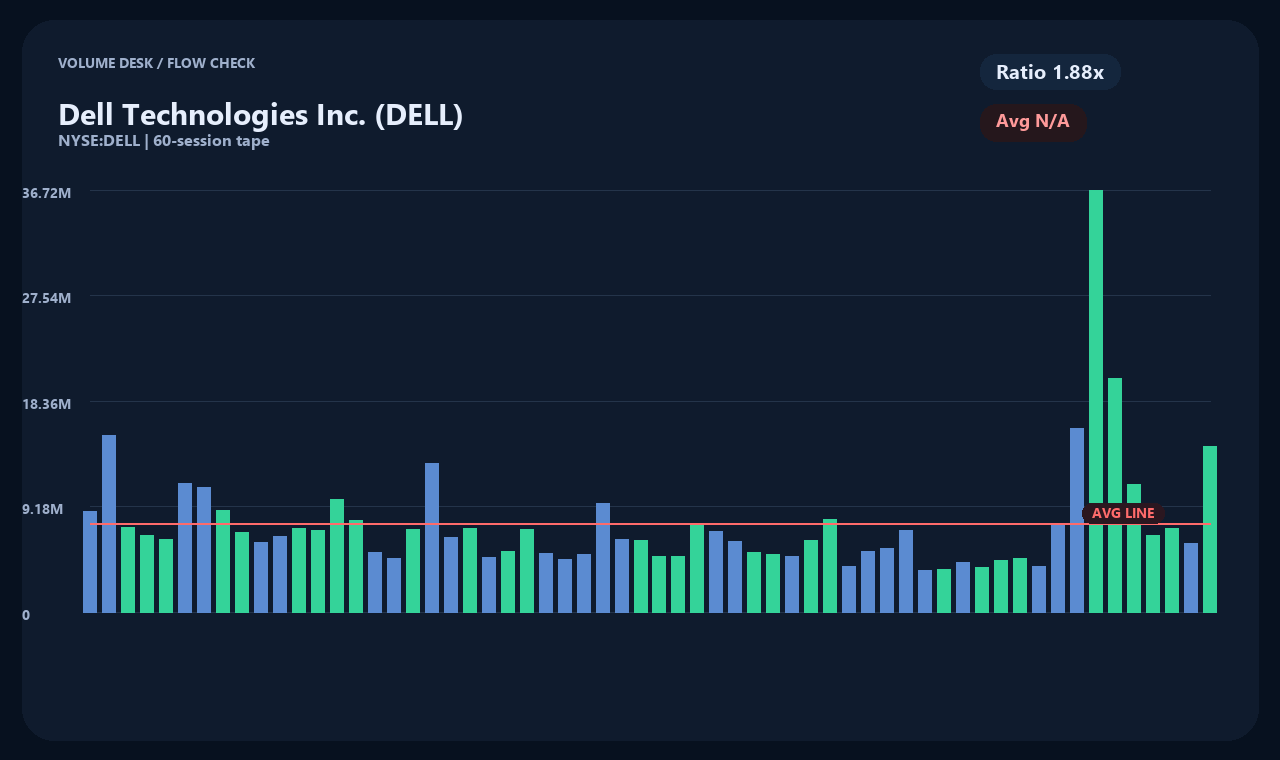
Trading volume also saw a marked increase. Daily volume hit approximately 14.36 million shares, roughly 1.88 times its average daily volume of 7.64 million shares. Heavy volume alongside a price surge simply reflects heightened market attention and does not directly indicate specific buyer identities or institutional intent. It is best interpreted purely as historical trade execution at elevated price levels.
Competitive Landscape and Market Assessment
Financial media outlets and broadcasters have offered varying assessments of Dell’s competitive positioning. For instance, reports note that commentator Jim Cramer highlighted Dell's supply security and strong customer relationships as competitive advantages over peers like Super Micro (SMCI). Component sourcing capabilities and enterprise customer networks have emerged as critical differentiators in the server hardware space.
However, media commentary does not guarantee long-term stock performance. Supply chain bottlenecks in global IT hardware remain a risk, and component imbalances in key AI semiconductors could cause shipment delays. Investors must continually evaluate quarterly execution and contractual deliveries rather than relying solely on news coverage or market rumors.
Key Factors to Monitor Moving Forward
To gauge Dell’s long-term valuation trajectory, investors should monitor whether projected financial targets smoothly translate into quarterly top- and bottom-line figures. Reaching the projected $192 billion annual revenue target depends on converting AI server backlog into actual shipments. Furthermore, tracking the conversion speed of backlog into net operating cash flow serves as a key metric for assessing earnings quality.
Additional catalysts include the arrival of the PC refresh cycle within the CSG segment and operating margin trends in the ISG division. Debt payoff progress and free cash flow sustainability are also vital metrics for balance sheet health. The sustainability of current valuation levels will ultimately depend on backlog realization and stable operating cash flows.
Data captured as of (2026-09-13T04:13:04): Price $567.29 USD · 1D 11.98% · 1W 9.86% · 1M 17.09% · 3M 44.92%
[Sources and Timestamp]
Market data: yahoo_chart_api · Timestamp: 2026-09-13T04:13:04. Reporting sources: MarketBeat, Insider Monkey, Moneywise. Article titles serve as reference leads; primary company filings and announcements should be independently verified.
This content is provided for informational purposes only and does not constitute investment advice.
This content is for informational purposes only and is not investment advice.
 StockBrief